rob balucas

Catalyst. Creative. Triathlete. Speaker. Cigar Aficionado. Amateur Behavioral Psychologist. Fresh Spring Roll Addict. Paraplegic at the moment.

  • what happened?
  • updates
  • speaking
  • race schedule
  • media
  • subscribe
  • support
  • 
  • 
  • 
  • 

powered by babaLucas

© Rob Balucas
All Rights Reserved

escape from alcatraz 2017 | race report

One of the things on my bucket list in this new form is the Alcatraz swim.

That’s where they take you from San Francisco to Alcatraz Island in a perfectly good boat and you jump out and swim back to San Francisco. It’s about 1.5 miles and if you don’t swim just right against the current, you’ll be swept out towards the Golden Gate Bridge.

I swam Alcatraz in the annual Sharkfest swim before I was injured and indeed was swept out so far that an escort boat had to pick me up.

The problem is that I was a poor swimmer prior to my spinal cord injury (SCI) and I’m worse now. I haven’t been able to swim all year because of pressure wounds on my ankles that haven’t healed since September of last year.

So while those are taking forever to heal, I’m handcycling and doing triathlons as a relay.

I found my way into the Escape From Alcatraz Triathlon this year as part of a relay along with Alan Shanken who is a below the knee amputee and has done every leg of this triathlon a number of times. We were a part of the Challenged Athlete Foundation contingent that was there.

When I got there in the morning, I found out the swim had been cancelled for the first time in the 37-year history of the race. There was a small craft advisory and heavy wind conditions that they deemed unsafe. So things started out with a bit of drama as race officials and racers figured out how to proceed with just the 18-mile ride and 8-mile run.

I was the only handcycle there this year. I quickly understood why. With 1,600 feet of climbing in under 18 miles of riding, it’s a tough challenge. It’s not something you just go do in a handcycle. I was out there for just under 2 hours. Most people on regular bikes take just over an hour.


So having plenty of time for thoughts to run through my head, here’s some of the more interesting items:

Don’t Be Afraid To Fail

Alan, my aforementioned relay partner, constantly asked me if I was ready for this challenge and if I think I could do it. Like up until the night before. And it really didn’t get into my head … until the night before. But I knew a couple of things:

I had done 1,600 feet of climbing once before, except over 35 miles of riding. It was last December when I was in far less racing shape. I was going for 50 miles but my arms gave out and the support van for our ride had to come get me. Now, I was in better shape and I knew what I was in for because I had ridden the course many times before I my SCI.

During check-in, the race organizers all knew who I was, as the only hand-cyclist. Which kind of worried me because it is a very technical course with a dozen left turns and a dozen right turns, many at the bottom of fast hills. But it also gave me comfort in that the staff on the racecourse were aware and prepared for me.

My biggest fear really was time. The original cut-off for the bike was 10:30am. If you were still on the bike leg at that time, a sweeper van would pick you up and take you to transition to go on to the run. My math looked like this: I do 18 miles regularly and it takes me about 1:15 (1 hour & 15 minutes) with 500 feet of climbing. Throw in another 1,100 ft climb to add 30 more minutes. My goal then was to do the ride in 1:45 and that gave me a buffer of about 30 minutes if Alan came in from the swim around 8:30am.

Besides the fact the swim was cancelled and the cut-off was extended, I was not picked up by the sweeper van and came in at 1:57 versus my 1:45 goal.

#GRIND

The biggest difference between handcycle and regular cycling is that you can’t put out as much power with your upper-body as with your legs. I say upper-body because the primary muscles used in handcycling are chest and back. Arms play more of a secondary role, as opposed to what most assume.

That being said, climbing is twice as hard and monotonous because you go about twice as slow.

Becoming a cyclist in the San Francisco Bay Area, I learned to love climbing. Partly because you have little choice with all the hills here and partly because the view from the tops are amazing. Eventually you get good at it and learn the nuance of technique.

But long climbs on a handcycle take twice as much patience and fortitude. There were many times in this race my Garmin GPS computer stopped while I was climbing because it didn’t think I was moving. Which by the way adds the biggest insult to injury when EVERYBODY – even the chump racing this TRIATHLON on a tourist rental bike – is passing you.

What I knew I had to do was buckle down and GRIND it out. Get my gearing right and just keep pedaling.

It felt like this race was 75% climbing. That means spending 75% of the time under 8mph. Then when I hit 30mph+ on a downhill, the distance was covered quickly before I was on another freaking hill climb.

Towards the end, I’d just find a marker 25 ft up the hill – like a traffic cone – and just keeping stroking to that cone and then the next and the next.

Keep Pedaling

I knew one thing for damn sure. I couldn’t stop pedaling.

There’s one stretch racers know called Seal Rock Drive. After you’ve climbed the hill starting at Ocean Beach and passing Cliff House Restaurant, you get a short reprieve before turning right onto this insane short hill that at it’s worst is 17.1% incline.

At that point I was 12 miles into the race and was warding off cramps with nutrition. Going in, this was the part we all were most concerned with.

But I buckled in. It was tough as all hell. I picked a marker 5 feet in front of me to get to – that’s how micro my goals were at that point – and then the next and then the next.

I. Just. Could. Not. Stop. Pedaling.

But I really wanted to stop.

Two things lifted me:

  1. The other racers screaming encouragement as they passed me.
  2. Me screaming at the top of my lungs like a maniac weight lifter.

I knew I’d laugh at myself later, but in the moment I let it all loose and could hear my screaming echo off the homes lining the street.

Coaching Pays In Spades

Throughout the race I could hear my coach laying out specific strategy on how to race. I can’t say enough about getting coaching in life and especially in triathlon.

In the first triathlon I raced in after my SCI, my coach Neil Fraiser, rode with me and just coached me through. Approaching a long incline he said, “…now just hit your Granny gears and settle in to the slow pace and go. Don’t kill yourself trying to go fast up the hill.”

That reminder to be patient and settle into a steady pace without using up all my energy was the entire strategy for this race.

I knew how and when to shift into what gear to keep steady cadence and maintain momentum both into and out of inclines and descents.

I knew how and when to hydrate, how and when to take energy blocks and what kind of energy blocks so as to maintain my energy and not bonk or cramp.

All because of great coaching that taught me race strategy.

The Love

One of the things I appreciate most about triathlon is the community. Because we’re pretty high on endorphins all of the time, we tend to be pretty lovey dovey.

All along the route I heard encouragement from other racers: ‘Good job, mate.’ ‘Nice work.’ And my personal favorite: ‘Respect.’

It was really cool in this race to hear it in American, Australian, Castilian and many other accents.

When I had breath, I made sure to return the love.

I also have to add that it was a privilege to race with the paratriathlon elites. It’s a small community which is great to be a part of. In the paratriathlon category at EFAT was Jamie Brown, who coached me at the CAF paratriathlon camp in 2015 and is currently ranked #1 in the world in his division; Mark Barr and Mo Lahna, both Rio Olympians; Willie Stewart, a parathlete advocate and legend. Oh and of course, my relay partner Alan Shanken, who’s work in the Bay Area and beyond on behalf of Challenged Athlete Foundation is very well-known!

One Last Story I Find Funny .. Now

The race starts with a nice 1.8 mile flat along the Marina and Crissy Field. Out of the shoot I was cruising at 15 mph, but it slowly decreased as I approached the first hill. Part of that was a headwind we’re all familiar with and the other was just coming out a little too hard.

The return is on the same course and I came off the last hill and did a 25 mph sprint all the way to the finish. Part of that I attribute to all the people cheering during that whole stretch as far more people come to cheer later in the race.

The other part was that I was doing nearly 40 mph coming off that hill.

I probably could have been going faster except for the turn at the bottom of that hill.

Also, I can’t promise all my wheels were on the ground at all times.

click on any image for full screen gallery

Shined up, greased down & ready to go!
Checklist Complete!
Checklist Complete!
Getting ready for take off
Holly Lawerence, 2016 EFAT Champion and Triathlon Pro Star! If the ladies crush on Andy Potts, then then the boys crush on her.
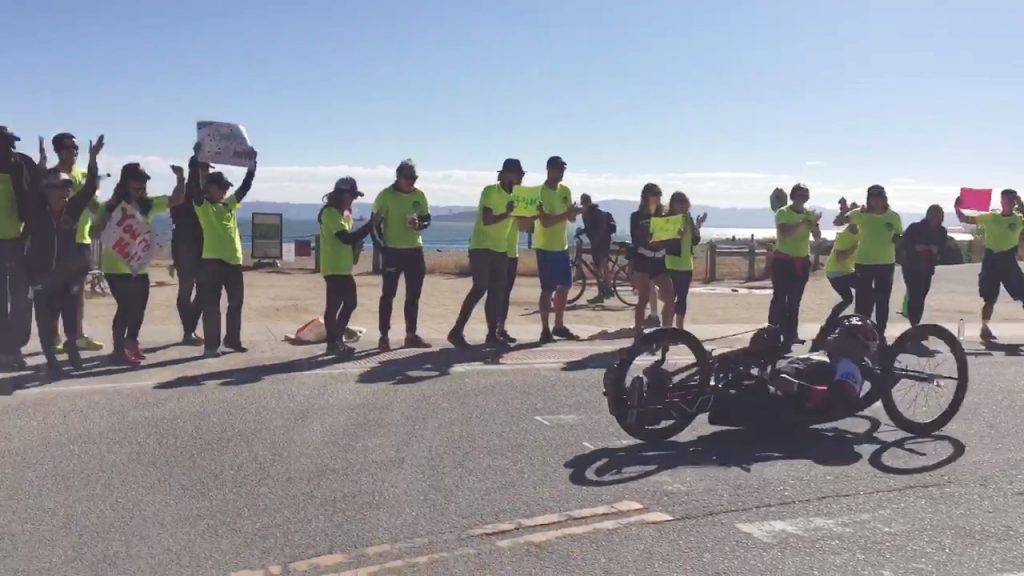
Golden Gate Tri Club here to Cheer!
Triathlon Legend Eric Gilsenan along with myself Alan Shanken, my relay partner & his wife, Alison Cacoma. All great people!
Max Fennell, Bay Area Pro Triathlete & friend
Got to ride some of my favorite streets of San Francisco again!
GGTC with the Love!
GGTC with the Love!
photo cred @patricia_dugan
photo cred Danielle Hauptman

June 21, 2017

on your left!

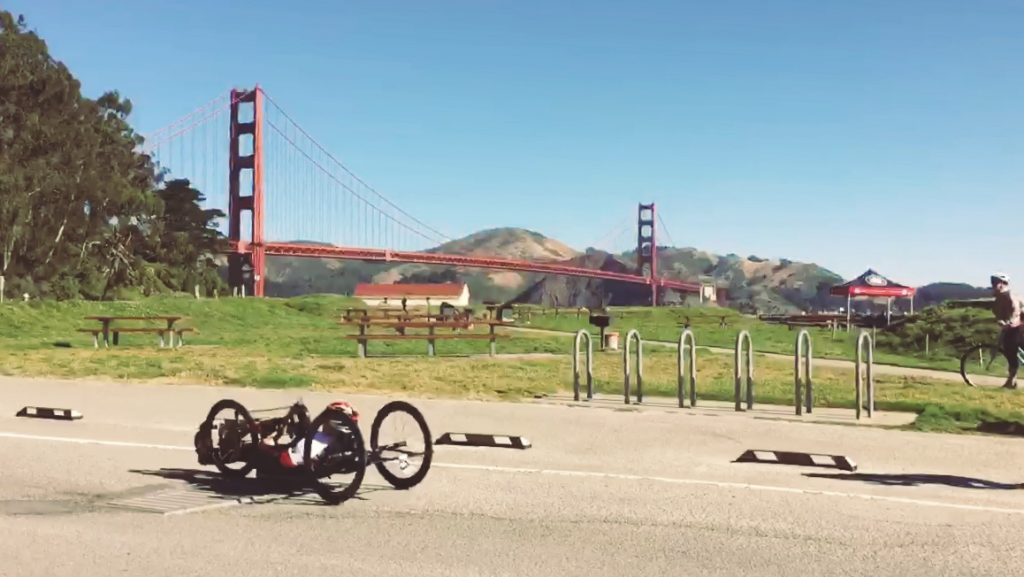
On your left! #downhill #aero #handcycle #ggtc @roseanneheras @goldengatetriathlonclub

A post shared by Rob Balucas (@robbalucas) on Apr 22, 2017 at 4:22pm PDT

April 22, 2017

california classic weekend

This weekend I rode a metric century including on a closed down freeway! It was amazing to get out with hundreds of other riders in the Central Valley of California.

Thanks to my college buddy, Ed Gonzalez, for riding with me out there!

Finishing strong #metriccentury #handcycle ????cred: @slackmak

A post shared by Rob Balucas (@robbalucas) on Apr 1, 2017 at 3:37pm PDT

April 1, 2017

EAT! (during your ride)

In a number of recent conversations I’ve had with fellow handcyclists, I hear a lot about cramping during longer rides.

It surprises me because I have learned over the course of triathlon camps, clinics and coaching that nutrition is the answer. You have to eat something as you go. If I know that’s the obvious answer, so does everyone else, right? 😉

I used to cramp like mad when coming off the bike and transitioning to the run when I was doing one triathlon a year. In 2015, I decided to get serious about my training and get coached. One of the first things I learned was proper nutrition and hydration during a long ride, training, or race.

The real key is to find what works for you. There’s a variety of gel shots, bars, blocks, waffles and homemade recipes you can find to help you stay hydrated, keep your energy up, your watts cranking, and mind clear.

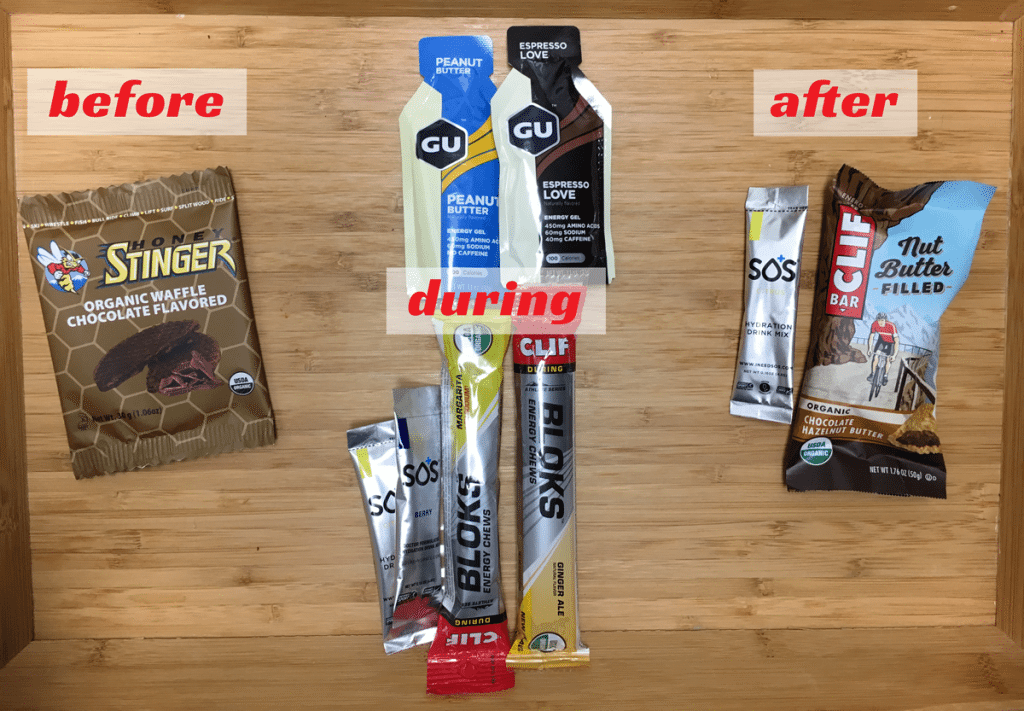
This is my nutrition plan for tomorrow’s metric century ride. The only thing you don’t see here is the oatmeal and half of a banana I eat when I wake up before the break of dawn.

My coach taught us this way: buy a couple of each brand & flavor. Try one brand per ride and see which agree with you and you can tolerate. Same goes for hydration supplements to add to your water bottle.

Through trial and error, you’ll find your mix.

On a basic ride of 20 miles, I’ll bring at least one gel and eat midway through the ride to keep me from cramping when I’m getting off the bike, which is crazy painful at my injury level.

Tomorrow during a 65-mile ride, I’m bringing enough for one gel every hour or 12-15 miles. That usually sees me through the 4-5 hour journey. If I wait until I’m hungry, it’s too late. I’ll have to work through the mental and physical valley while my body pumps the fuel back through my system.

Oh and post-race! I know that most feel like they’ve earned pizza, bacon cheeseburger, and fries and beer after an event like that. Or maybe I should say that I do. I’ve learned that if I want to keep to my healthy weight and not punish my system, that a balanced selection of carbohydrates and proteins immediately after the finish line is also on optimum window to replenish and rebuild.

If you’re in Central California, join us at the California Classic Weekend!

March 31, 2017

go to lunch

I saw this interview the other day with RJ Mitte. RJ played the son of Walter White in the show Breaking Bad. Breaking Bad I had always heard of, but only finally binged watched it with my parents after coming home from the hospital. RJ has cerebral palsy and gave this interview:

It reminded me of an awareness I came to one Friday night:

After rehab I went live with my parents in Fresno for about 8 months. I was out to dinner with a friend on a Friday night before going to see a movie. We went to a hot spot in town that had a 45 minute wait (that was really only 20 minutes).

Just a tangent, because people who’ve spent a lot of time with me know I love my tangents: aside from places like Mama’s in San Francisco or certain restaurants like that, most 45 minute waits really are 20 minutes at most.

We were seated, we ordered drinks, we ordered food and I then looked around. This was about 4 or 5 months into being out of the hospital. What I noticed was zero other wheelchairs in this large restaurant. Then I thought to myself, ‘Have I seen a wheelchair in public since coming out of the hospital?’

The answer was 1. I met a really outgoing guy my first day at the gym who was in a wheelchair and stoked to see someone else in a chair. But this wasn’t the first time I’d been to dinner and a movie, working in a coffee shop, shopping for shoes I don’t need, or going to Trader Joes. Okay, there was this old dude at Trader Joes with a milk crate strapped to his lap with bungie cords. This was super ingenious because anything after 4 things in your lap is bound to fall off with the slightest bump. I’ll never strap a milk crate to my lap with bungie cords because that’s ridiculous-looking and me saying that is counter-intuitive to everything I’m about to say. But hey, we all have our limits and ? we’re working through. Maybe if I’m still in this wheelchair at 70+ I’ll cave. I digress.

So back to the point, that’s 2 people out there in 8 months.

I asked my friend at dinner, ‘Why is it that there aren’t more people in wheelchairs out and about? The world is pretty accessible and legally it has to be, right? I’ve yet to go to a restaurant or coffee shop where I can’t get in or pull up to a table. The movie theater has rows for me to sit in, even though I prefer to transfer into a normal seat anyway. Why don’t I see more people out there?’

‘Because they are ashamed to be out in public. They don’t like the stigma.’ she replied.

Kind of obvious. My friend is a Physical Therapist, so she knows firsthand what it is like. I wanted to revolt because I have this belief that stigma and judgement and funny looks and all that only have the power that you give them. I believe that people fall in line with how you see yourself. You are a leader. If you say, ‘I’ve had a crappy day and my life isn’t going the way I thought it would because I couldn’t get that hair appointment I wanted’ people will believe you and console you and cup your elbow and say, ‘Poor baby.’ And so goes your life.

But if you fall off your bike and end up in a wheelchair and say, ‘You know what. I’m going to do a triathlon, except as a paratriathlete.’ People will say, ‘Wow that’s amazing and super impressive! How can I help you?’

But I knew she was right. Not everyone has been exposed to that idea. And it’s kind of tragic that that is the case.

The other day I was in-between doctor appointments and craving BBQ from a favorite restaurant. I went through it. Counter to everything I just wrote, I didn’t want to hassle with getting my wheelchair in and out of my car, I didn’t want to miss my timing and fumble through opening the front door, I didn’t want to be a guy in a wheelchair in a busy restaurant right in the center of town with all the pretty people right at lunchtime, and I didn’t want to deal with people looking at me.

But then I did what I usually do. I said ‘fuck it.’ After all, I’m a pretty people too (less I forget).

I went to the restaurant. I fumbled through the door. I sat on the patio because it was a nice day, right on the sidewalk. Other pretty people walked by. They walked in and out of the restaurant right past my table. I asked the waitress to change the TV to Olympic Volleyball. I watched the US fall to Russia in the bronze medal match. I ate my Brisket salad. I flirted with a girl over text. I smiled at people who I made I contact with. I paid my bill. I took off for my doctor’s appointment, and life went on.

RJ Mitte is right. I hope a lot of disabled people see his message. When you want to do something, go to it. Don’t hide your disability. Don’t hide who you are or what you are. Show it to the world. Not by Snapchatting or posting it to Twitter, but getting out IRL. Go rock climbing or paddle boarding. Go to lunch and flirt with the girl. Go do things you want to do.

And that goes for you able-bodied people too. Take it from me, it could be snatched from you in an instant.

Now get on it while I Snap this and post it to Twitter.

September 9, 2016

  • « Previous Page
  • 1
  • …
  • 9
  • 10
  • 11
  • 12
  • 13
  • …
  • 34
  • Next Page »